Our goal is to make India a global hub for millets and mustard. For this, it is necessary not only to preserve traditional farming practices but also to promote technological research and innovation. This was stated by the Union Minister of State for Agriculture and Farmers Welfare, Mr. Bhagirath Choudhary, while addressing the Rajasthan Millet & Mustard Conclave 2025 held today in Jaipur through video conference. The event was organized by FICCI Rajasthan in collaboration with the Department of Agriculture (DOA), Rajasthan on the theme “Resilient Crops with Innovative Technologies”. The Minister further said that under the leadership of Prime Minister Narendra Modi, India has given millets a new identity on the global stage. By celebrating 2023 as the International Year of Millets, the message was clear millets are not only a cornerstone of nutritional security but also a significant step towards agricultural and nutritional security. Today, India is the largest producer of millets in the world, with Rajasthan contributing the most to this achievement.
Additional Director Agriculture (Extension), Agriculture Department, Government of Rajasthan, Mr. S.S. Shekhawat said that Rajasthan continues to lead the country in rapeseed-mustard production, contributes significantly to overall oilseed output. He noted that Rajasthan has implemented a completely paperless application system through the RajKisan Saathi portal, with 100 % of agricultural schemes available online and real-time tracking of application status via web and mobile apps. He also shared that a Centre of Excellence for Artificial Intelligence in Agriculture is being established in Rajasthan to integrate advanced technologies and improve productivity in the sector. Mr. Shekhawat also announced that The Global Rajasthan Agritech Meet (GRAM) will be held once again from 10–12 January, 2026 at JECC in Sitapura, where around 70,000 farmers will participate.
Director (Oilseeds), Department of Agriculture and Farmers Welfare, Ministry of Agriculture and Farmers Welfare, Government of India, Mr. Sharad Kumar Dwivedi in his video message, emphasized that Rajasthan has always led the way in sustainable farming and value chain development. As one of the India’s leading mustard producing states, It plays a vital role in our journey towards Edible Oil, self Reliance. He said that through this conclave, practical strategies and solutions will emerge, which will prove useful for policy reforms and technological innovations.
In his special address, Vice Chancellor of Sri Karan Narendra Agriculture University (SKNAU) Jobner, Dr. Balraj Singh said that historically, India’s per capita edible oil consumption was around 7–8 kg per year in the early 1980s–1990s, but changing dietary practices and rising incomes have pushed this number up to 17–18 kg today. He pointed out that a large share of this demand is still met through imports, making India heavily dependent on foreign markets. Mr. Singh underscored the Prime Minister’s vision of reducing this dependency — a goal that would serve a dual purpose: improving public health by bringing consumption closer to recommended levels and reducing the country’s import bill by boosting domestic oilseed production.
Additional Director Agriculture, Agriculture Department, Government of Rajasthan, Mr. Ishwar Lal Yadav highlighted Rajasthan’s significant contribution to the country’s agriculture, noting that the state accounts for 41% of India’s millet production and 45–50% of the nation’s mustard output. He emphasized that both crops are well-suited to Rajasthan’s climate and require relatively less water, making them ideal for cultivation in the region. He also shared that a Centre of Excellence is being developed in Jodhpur to conduct research on ‘bajra’.
Joint Director Agriculture, Government of Rajasthan, Mr. Ajai Pachori highlighted the diverse nature of farming in Rajasthan, which includes both dryland and irrigated agriculture, with a wide range of crops being cultivated. He emphasized the need for innovative techniques and collective efforts to make farming more self-sufficient. Mr. Pachori also underlined the importance of adopting sustainable practices.
South Asia Seed Marketing & Agronomy Director and Bangladesh Business Lead, Corteva Agriscience, Ms. Surabhi Rana stressed that Mustard and millets are critical crops for Rajasthan and India. As traditional, climate-resilient, and water smart crops, they play a key role in ensuring nutritional security, rural prosperity, and climate resilience. Increasing their production is vital for better nutrition and greater oilseed self-sufficiency, helping reduce reliance on imports. To unlock the full potential of these crops, we need a farmer-centric approach that integrates research, policy, and market frameworks. Corteva believes in value driven approach that responsibly boosts yields and productivity by putting advanced technology in the hands of farmers.
Earlier, Co-Chairman of FICCI Rajasthan State Council and Chairman of Shahpura Hotels & Resorts, Mr. Surendra Singh Shahpura, in his welcome address, said that agriculture is the backbone of the nation’s development. He emphasized that their objective is to empower farmers and youth by blending tradition with modernity. He also highlighted the need to connect farmers with tourism by promoting farm tourism, agro-tourism, and rural tourism.
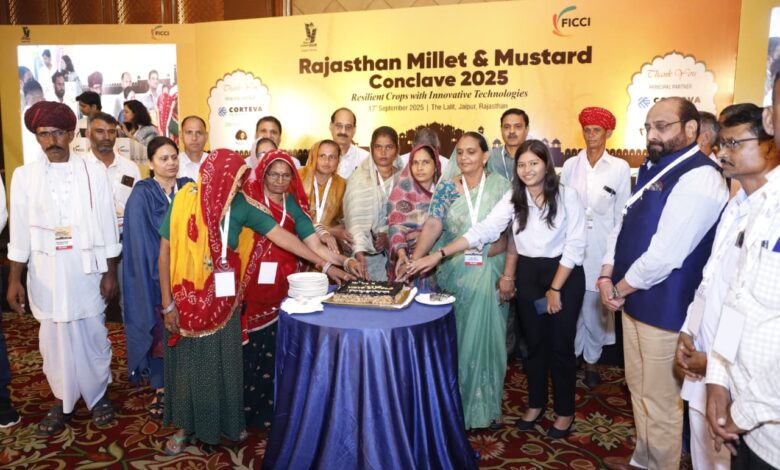
The conclave also featured two plenary sessions. The first session on “Millets – Unlocking Potential for Sustainable Agriculture” brought together experts to discuss the current status of the millet value chain, its challenges and emerging opportunities. The second plenary session on “Mustard for India’s Edible Oil Security: Innovations, Markets and Policy Pathways” focused on innovations, adoption of hybrid seeds, and advanced farming practices to enhance mustard productivity. On the occasion a bajra cake cutting ceremony was also held by women farmers. The Vote of Thanks on the occasion was delivered by Director & Head, FICCI Rajasthan State Council, Mr. Atul Sharma.