Book discussion on ‘Kashmir in the Line of Fire’ by Maj. Gen. Ranjan Mahajan (Retd.)

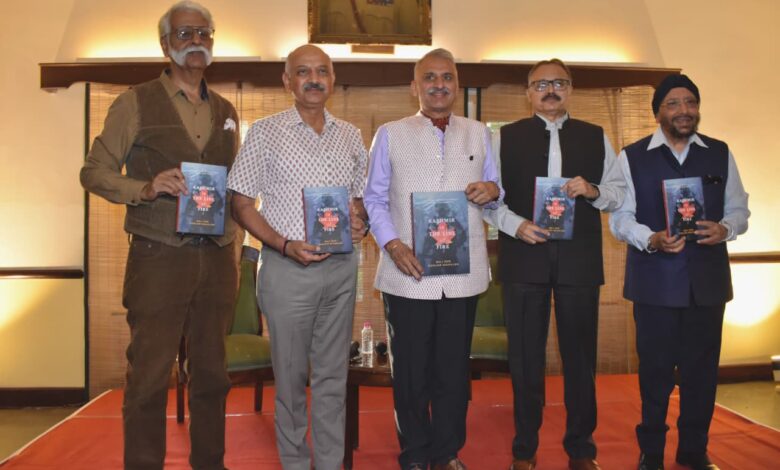
Jaipur : In an insightful book discussion on ‘Kashmir in the Line of Fire’, the author Maj. Gen. Ranjan Mahajan (Retd.) threw light on the role of the Indian Army where they faced extraordinary times with valour and courage. He was speaking at a book session organised at the Ashok Club today. He was in conversation with Jaipur-based author and publicist Jagdeep Singh. The author shared compelling experiences from his extensive service of 15 years in Kashmir, spread over 5 tenures. He offered the audience a rare glimpse into the realities of conflict, leadership and human resilience. The book was formally released by DG Police of Rajasthan, Mr. Rajeev Sharma and Chief of Staff, South-Western Command, Lt. Gen. Padam Singh Shekhawat and Mr. Ajay Singha.
Speaking about his motivation behind writing the book, Maj. Gen. Mahajan said that the memoir was born out of a desire to document lived experiences and present an authentic account of Kashmir beyond headlines. He shared that the writing process took several years, involving recollection, structuring of field experiences, and careful reflection to ensure both accuracy and sensitivity. One of the unique aspects of the book discussed during the session was the integration of QR codes that allow readers to access real-time visuals, including helicopter operations. He explained that this innovation was aimed at enhancing reader engagement and offering a more immersive understanding of military functioning, especially for civilians unfamiliar with such environments.
Elaborating on the role of the Rashtriya Rifles, he explained its origin as a specialised counter-insurgency force, structured by drawing personnel from various army units. He highlighted that while regular battalions are trained for conventional warfare, Rashtriya Rifles is specifically oriented towards sustained counter-insurgency operations in regions like Kashmir. Reflecting on operational challenges, he emphasised that every movement outside secured bases involves significant risk.
The discussion also touched upon the painful exodus of Kashmiri Pandits, which he described as one of the most emotionally difficult chapters to witness during his tenure. He spoke with sensitivity about the human cost of conflict and the lasting impact on displaced communities. Sharing lesser-known anecdotes, he recounted incidents including that of a soldier who inadvertently crossed the border and was later manipulated into espionage, illustrating the complex psychological dimensions of conflict. He also narrated inspiring stories of soldiers from humble rural backgrounds who displayed extraordinary courage and rose as heroes in challenging situations.
The session concluded with an engaging Q&A, where the audience interacted with the author on themes ranging from military strategy to the evolving situation in Kashmir. Earlier, the Welcome Address was delivered by Mr. Ajay Singha, while the session concluded with a Vote of Thanks by Ms. Tusharika Singh.